Growth and traffic are quality-of-life issues we all feel every day.
Fifteen years ago, Florida changed its transportation planning requirements. In 2011, the State gave local governments greater flexibility to move beyond traditional transportation concurrency and use broader methods for measuring the effects of growth on traffic.
Boca didn’t change its system. As the city continued to grow, we continued measuring traffic largely the same way we had before the State provided broader and better ways to do it.
It’s time to catch up and modernize how we measure traffic—and measure it the way we experience it, across an entire area.
What We Measure Today
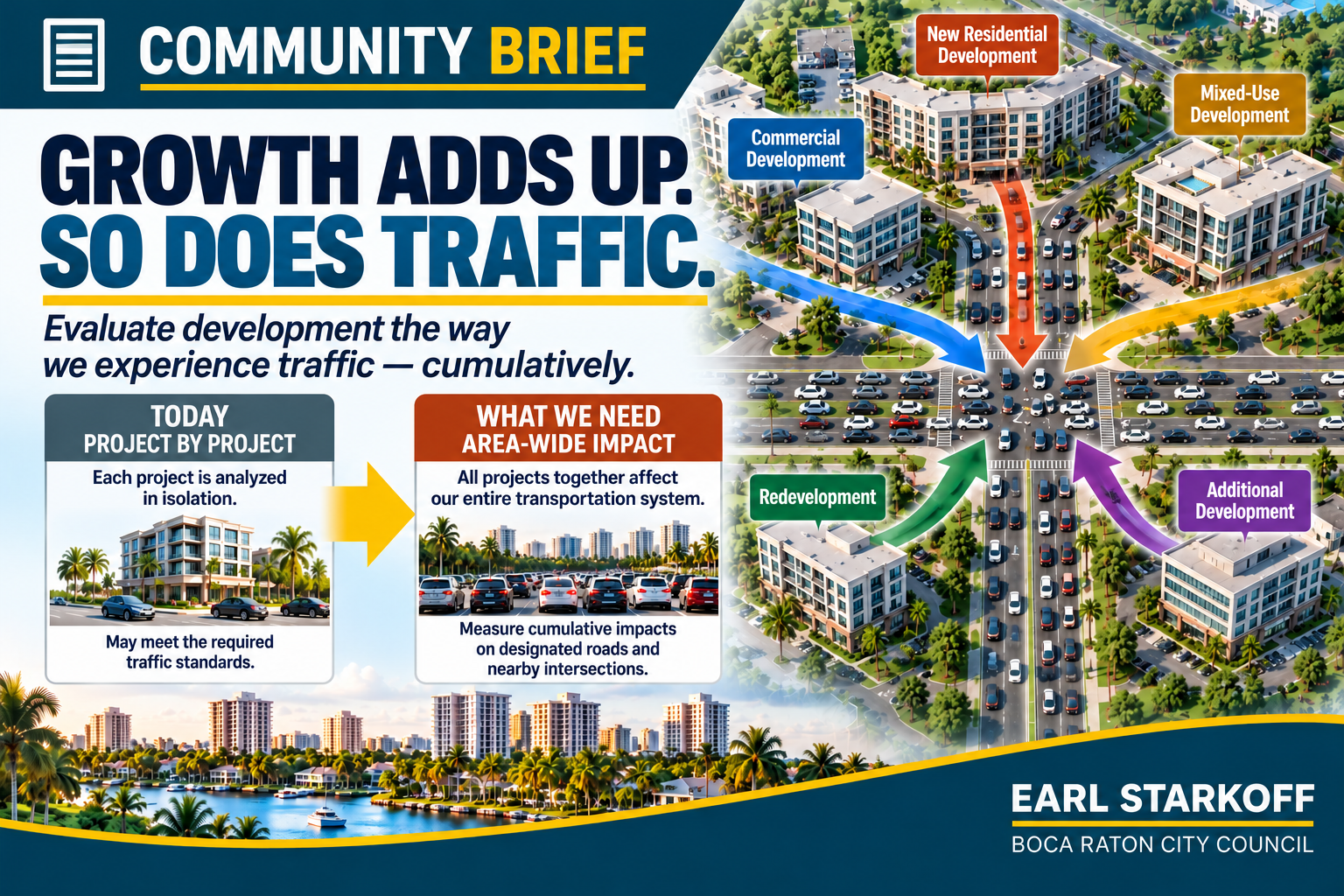
Today, when a project is proposed, a traffic study estimates how many trips that project will generate, where those trips are expected to go, and their impact on nearby roads and intersections.
That’s the problem. The study starts with the individual project and measures the traffic generated by that project.
But that is different from measuring the cumulative effect of projects occurring and potentially occurring throughout an area.
Residents don’t experience one project’s traffic at a time. We experience all of it together.
We Experience the Whole System
Consider projects around Congress Avenue and Yamato Road.
Their traffic doesn’t remain on Congress and Yamato. It moves through Yamato Road, Clint Moore Road, Congress Avenue, Military Trail, Jog Road, Federal Highway and I-95.
The same thing happens Downtown, where projects affect Palmetto Park Road, Camino Real, Federal Highway, Dixie Highway and the surrounding streets.
Development is reviewed project by project. But as State law and County regulations recognize, traffic is experienced across an entire road system.
That is the disconnect we need to fix.
Change the Method of Counting
We need to measure traffic cumulatively across an entire area. That means measuring traffic flow across the roads and intersections people actually use.
The standard should be common sense: count traffic the way people actually experience it, as State law and County regulations recognize and intended.
When traffic backs up on Yamato, it affects Congress, Military Trail and I-95. When traffic backs up Downtown, it doesn’t stop at the boundary of the project that generated some of it.
That’s how traffic really works. Our method of counting it should reflect that reality.
That will give Boca the information it needs to make decisions about projects before those decisions add to congestion.
This is about protecting our quality of life as Boca continues to grow.
Downtown — and What Comes Next
Downtown is an obvious place to use this broader approach to better control the projects that could still be coming and avoid adding to the traffic problems we already have.
But it is equally important in other parts of Boca where significant projects are already happening and more will come.
The Congress Avenue/Yamato Road corridor extending north toward Clint Moore Road and beyond is one.
The area around Town Center Mall and west of I-95 is another.
Downtown shows us where the consequences of the current system have already occurred. Areas west of I-95 give us an opportunity to use better information before future project decisions are made.
We should not repeat the same mistakes.
A Better Way to Plan
Modernizing the way we count traffic gives Boca a better, more comprehensive planning tool.
When a new project comes before the City, we should know what it means for traffic flow throughout the surrounding area—not just what it means for the roads and intersections closest to the project.
That information matters when we make decisions about development, zoning and the transportation improvements Boca will need.
And it matters to residents because those decisions determine what our roads will look like five, ten and twenty years from now.
Once a project is built, we can’t simply take it back.
We need better information before we approve it.
Start Now
Most of the standards and study methodologies needed to do this are already known.
What we need now is direction from the City Council to modernize Boca’s traffic-counting system and a timeline from staff to put it into effect.
There will be steps to complete and coordination with Palm Beach County and the State.
That’s exactly why we need to start now.
Every project approved while we wait becomes part of the traffic we will live with for decades.
Florida opened the door to a broader approach 15 years ago. Boca should walk through it.
That’s not anti-growth. It’s better traffic planning.
If we experience traffic cumulatively, we should measure it cumulatively.